Russ ‘The voice’ Bray

Russ 'The Voice' Bray

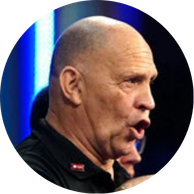
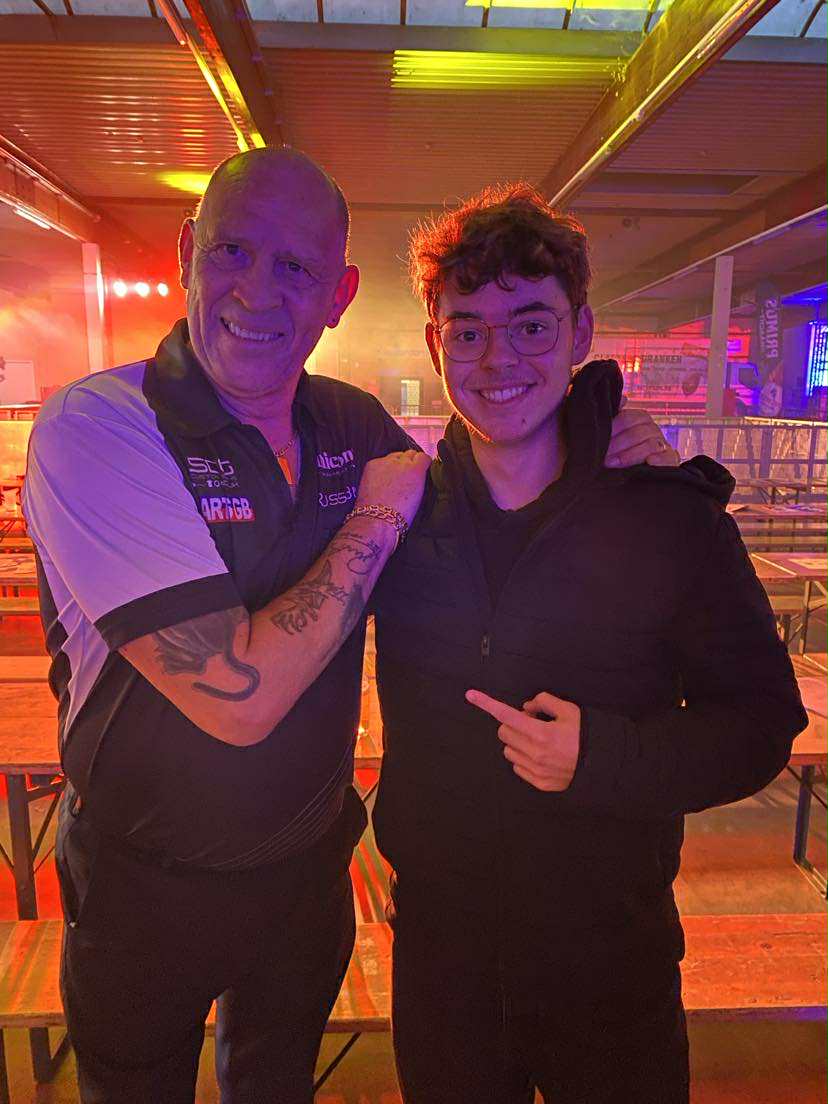
Russ Bray, caller at the PDC

"You’re not just counting, you’re the referee."

Dartschool: Fans know you as “The Voice.” On stage, what’s the caller’s real job?

Russ Bray: Calling the score is just the start. You’re the referee up there, the person in charge. Be clear, concise, fair but firm, and completely impartial, even if close friends are playing each other. That authority keeps a match calm and professional.

So when there’s no separate stage ref, what changes for the marker?

The marker becomes the referee by rule. You must be accurate, composed, and in control. What helps massively is knowing the players’ preferred routes to finish.

James Wade for instance likes to leave tops and tens. Luke Littler gravitates to tops, tens, 15s. Luke Humphries loves 32 (D16). On 82, Humphries might go bull → D16, while Littler often goes T14 → tops - context matters.

Who keeps a scorer guessing?

Michael Smith and Rob Cross will take unusual lines now and then. Gerwyn Price sometimes engineers 24 because he loves D12 - it can catch you if you’re not ready.

We see more double–double finishes. Trend or hype?

Real trend. With 72 you’ll see D18 + D18, even D19 + D19 now. Years ago you’d never see people try to double 19.

Also, bull/25 is used a lot more than “back in the day.” There was a time when going for bull looked like showing off. I remember Phil Taylor vs Kevin Painter at Circus Tavern. Phil won on bull while Kevin was miles off a finish; Kevin took numbers because it felt like taking the mickey. Today? Bull is just another double.

What about outright errors as a marker, how do you recover?

Forget it and move on. Players make mistakes too, they aim 10 and hit 15. Correct it and carry on; don’t let one slip snowball into the next leg.

Foto van Kim Huybrechts in discussie met Russ Bray

(c) Alamy

Any rhythm/timing advice for people at the scoreboard when play gets fast?

Take your time. If you’re not sure, make sure. You can hold the throw briefly to confirm the score, that’s better than guessing.

The rules allow players to ask two things: “What’s scored?” and “What’s left?” I’d actually like to remove “What’s left?” at pro level, it’s their job to know. But while it exists, you must answer quickly and accurately.

Foto van Daniela als schrijver van de PDC met Russ Bray

(c) Alamy

That can be mental arithmetic at speed.

Exactly. Example: Mervyn King once had 142. He hit T20… then aimed for T14 but hit T11, and asked “What’s left?” I had to recompute instantly: 142 − (T20 + T11) → T49 remaining; he went T17, leaving 32. That’s how fast your head must work.

Tablets are everywhere in leagues. Helpful or harmful for learning to mark?

I’m old-school. In pub darts you had to mark or you didn’t play, and that’s how you learned. Tablets make it too easy and don’t help the on-stage referee; your brain still has to do the work. They’re great for stats and remote formats, but they don’t replace judgement or voice. Pen-and-paper teaches the craft.

For a young marker taking an important match: three things to focus on?

  1. Know your board and numbers. Have go-to routes in your head.
  2. Know player tendencies (tops/tens vs D16, bull habits).
  3. Control the tempo: breathe, verify, announce clearly. If needed, pause and confirm.

How did you become the man with the mic at the Professional Darts Corporation (PDC)?

County match ref didn’t show; I jumped in and loved it. Later, during the WDC/PDC split, I accepted a reserve-ref invite. Blackpool 1996 was the break, after I called two early (non-live) matches, tournament director Tommy Cox said, “We’re having three referees, welcome.” Next big ones were the 1996/97 Worlds.

Numbers always came easy to you?

Yes, darts is number sequences, and I’ve always been decent at arithmetic. It helps.

Still get nervous?

No, after this many years I look forward to games rather than fear them.

How do refs share a session practically?

Depends on format. At the World Series in Saudi, best-of-11, we did two on, two off. At Worlds, often two refs per session, alternating one on/one off.

We always ask this to our guests: what darts do you personally throw?

Unicorn made my signature set, 21g Russ Bray darts. They’re not on sale now, but that’s what I use

To conclude, if a reader remembers just one thing from you?

Learn the board. Learn your numbers. If you miss here, you know where you go next, everything gets easier from there.


Interview by Tommy (Dartschool). Edited for clarity and length.

Want to do it yourself?

Darts Scoring Made Easy

Would you like to effortlessly master the art of darts scoring? Then this e-book is perfect for you.

Darts Checkouts - From Beginner to Advanced

This e-book is a practical guide that teaches you to think for yourself about check-out routes.

Darts – Checkouts from 60 to 100: The Quick Fix

A quick and easy method to memorize and apply dart checkout routes. With many practical solutions.

Darts – Mentally strong at the scoreboard

An approachable guide with 7 mental tips for those who want to learn to write dart scores with more confidence.

Read these interviews also

  • Behind the scenes at Top of Darts: Bert inputs the scores

    At Top of Darts in Belgium, Bert stepped behind the scenes three times as a score operator. He types in the thrown scores live, after which the digits immediately appear on the large screens next to the players. No glamorous spotlight, just pure focus. How do you end up there, what does the setup look like, and what do you do if the caller says something different than what you saw? We asked Bert.

    Read more
  • Laszlo Gyimothi – CEO Scolia

    Auto-scoring systems like Scolia are sometimes accused of making players “lazy” at counting. In this interview Scolia’s CEO, Laszlo Gyimothi, explains how auto-scoring lowers the entry barrier and can improve your darts math, if you use the right training toggles and games.

    Read more
  • Elias Van Den Borre

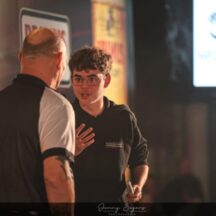
    Top of Darts in Affligem was the perfect stage for 16-year-old Elias Van Den Borre to make his debut as a marker. Live, under pressure, and reassured by caller Russ Bray.

    Read more
  • Foto van Kim Huybrechts in discussie met Russ Bray

    Kim Huybrechts

    Kim Huybrechts is one of the top professional Dart Players in Belgium and one of the two players representing Belgium at the World Cup.

    Read more
  • Foto van Jacques Nieuwlaat als mastercaller

    Jacques Nieuwlaat

    Jacques Nieuwlaat is not only a darts commentator on television in the Netherlands, but also a true darts guru. He is a former caller for the PDC and is thus very familiar with scoring and writing. That's why he is aptly nicknamed the Human Calculator.

    Read more
  • Foto van Daniela als schrijver van de PDC

    Daniela Bata-Bogdanov

    Daniela has been part of the marking team at the PDC. In 2019 at the World Cup of Darts, she was the first female stage official at a big televised PDC event.

    Read more
  • Foto van Dave Joacim als caller tijdens het TV-programma BV Darts

    Dave Joacim

    Dave has been a mastercaller in Belgium since 2006, with extensive stage experience at both PDC events and regular tournaments. A few years ago, he also appeared as the Mastercaller on the TV show BV Darts.

    Read more
My cart
Your cart is empty.

Looks like you haven't made a choice yet.