Bert
Score operator at Top of Darts
"They were looking for someone who could calculate quickly and calmly"
At Top of Darts in Belgium, Bert stepped behind the scenes three times as a score operator. He types in the thrown scores live, after which the digits immediately appear on the large screens next to the players. No glamorous spotlight, just pure focus. How do you end up there, what does the setup look like, and what do you do if the caller says something different than what you saw? We asked Bert.
Dartschool: How did that opportunity come about?
Bert: Together with Dartshop Madhouse, we had a stand in Kortrijk for Top of Darts. During the first match, it was noticed that entering the scores on the boards wasn't going very smoothly. Someone from the organization asked if 'anyone was good at mental math' to take over. I said 'I'd be happy to do that.' A unique experience! That’s also where I met the spotter and we were off.
Were you extensively briefed?
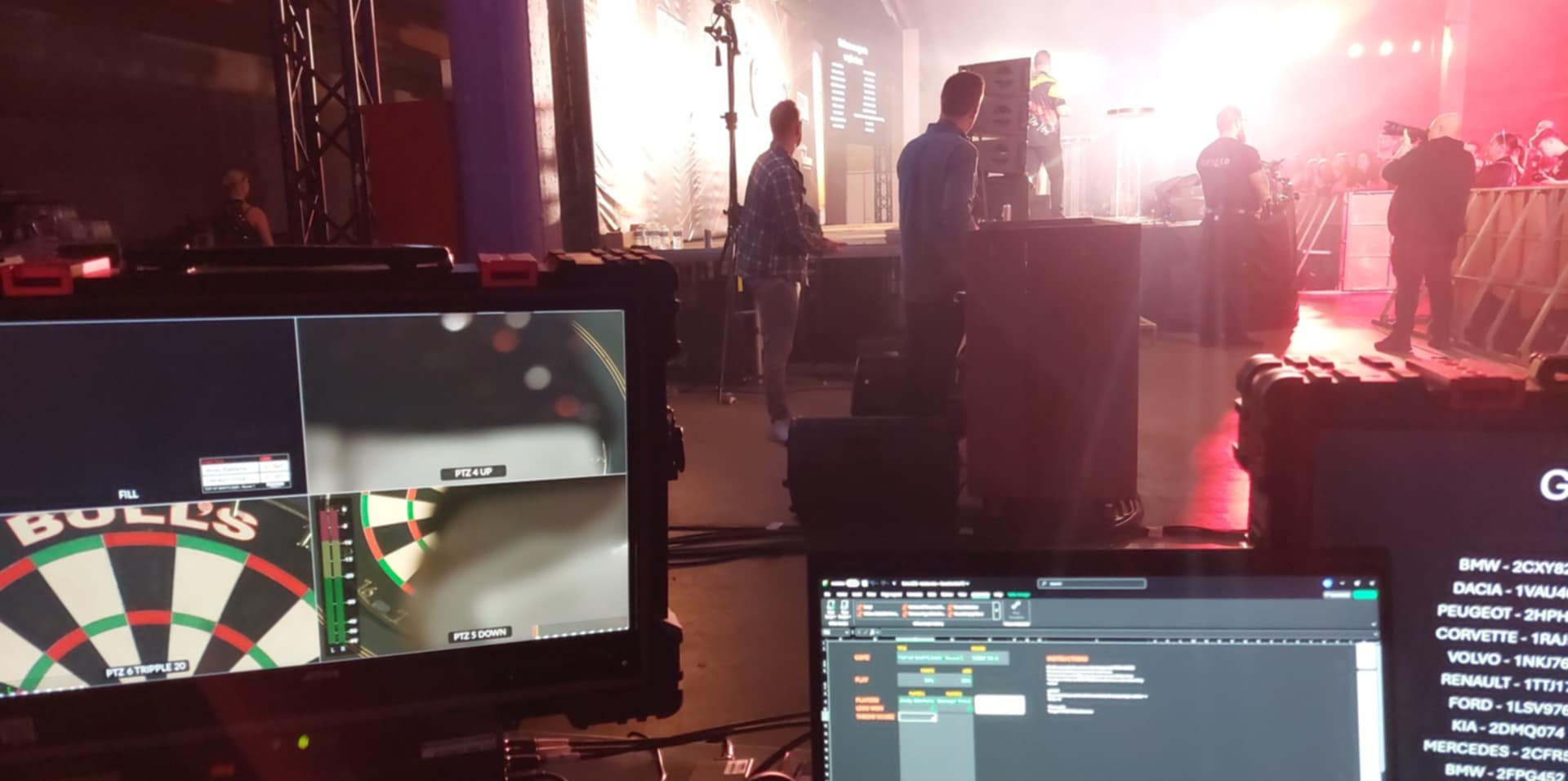
I received a general explanation of how it works and within moments it was time. I was given a laptop, several screens, and a headset connected to the caller. For the first few arrows, I didn't even have a good front-facing view. That was a bit of a search.
What does the control room look like?
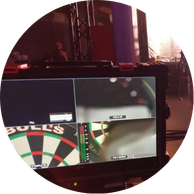
We sit with 2–3 screens. The spotter operates buttons for camera angles (20-bed, 19-bed, full frame...) and switches along live. I type in the scores, but it is the caller who speaks 'the truth.' If I think it's 82 and he says 92, I have to follow the caller.
Can you always hear the caller clearly?
Usually yes via the headset, but sometimes it's tough. That’s why I always ask to have the right screens in front of me, preferably a top-down view of the board. That provides peace of mind.
What happens if there is a misunderstanding or an error?
Then we correct it immediately. If necessary, we turn off the projection for a moment and check with the written scoreboard so everything matches again. The important thing is: don't get stuck on it. Fix the error and move on.
Were you nervous, especially that first time?
"I prepare during the warm-up: I set up my screens and already start counting along. Real stress only hits after the first mistake. My trick: resetting. A new throw is a new opportunity."
Where exactly were you located in the venue?
"That varied: to the left of the podium, sometimes at the back of the room, depending on the edition. Being at the back of the room is harder. But as long as I have the caller and a good view, I am happy."
How many matches do you input on an evening like that?
"Roughly eight. It’s a long time, but if it’s your passion, you stay sharp."
PS: Interested in Bert's Best Math Tips?
Bert also shared concrete tools to write faster and more calmly (e.g., learning patterns, warming up smartly, preventing column errors). You can find his tips here.
Want to do it yourself?
Darts Scoring Made Easy
Would you like to effortlessly master the art of darts scoring? Then this e-book is perfect for you.
Darts Checkouts - From Beginner to Advanced
This e-book is a practical guide that teaches you to think for yourself about check-out routes.
Darts – Checkouts from 60 to 100: The Quick Fix
A quick and easy method to memorize and apply dart checkout routes. With many practical solutions.
Darts – Mentally strong at the scoreboard
An approachable guide with 7 mental tips for those who want to learn to write dart scores with more confidence.
Read these interviews also
-
Russ ‘The voice’ Bray
In this exclusive interview, PDC icon Russ “The Voice” Bray shares his essential insights into the role of the caller and the marker in the world of darts. According to Bray, a good official is much more than just a counter; you are the referee who maintains calm, authority, and impartiality on the stage.
Read more -
Laszlo Gyimothi – CEO Scolia
Auto-scoring systems like Scolia are sometimes accused of making players “lazy” at counting. In this interview Scolia’s CEO, Laszlo Gyimothi, explains how auto-scoring lowers the entry barrier and can improve your darts math, if you use the right training toggles and games.
Read more -
Elias Van Den Borre
Top of Darts in Affligem was the perfect stage for 16-year-old Elias Van Den Borre to make his debut as a marker. Live, under pressure, and reassured by caller Russ Bray.
Read more -
Kim Huybrechts
Kim Huybrechts is one of the top professional Dart Players in Belgium and one of the two players representing Belgium at the World Cup.
Read more -
Jacques Nieuwlaat
Jacques Nieuwlaat is not only a darts commentator on television in the Netherlands, but also a true darts guru. He is a former caller for the PDC and is thus very familiar with scoring and writing. That's why he is aptly nicknamed the Human Calculator.
Read more -
Daniela Bata-Bogdanov
Daniela has been part of the marking team at the PDC. In 2019 at the World Cup of Darts, she was the first female stage official at a big televised PDC event.
Read more -
Dave Joacim
Dave has been a mastercaller in Belgium since 2006, with extensive stage experience at both PDC events and regular tournaments. A few years ago, he also appeared as the Mastercaller on the TV show BV Darts.
Read more